
Excited for IndieWebCamp tomorrow.
Excited for IndieWebCamp tomorrow. If you’re disappointed in modern social networks and looking for what’s next on the open web, I hope you’ll join us at Capital Factory in Austin. More details and registration here.
First time at Capital Factory?
First time at Capital Factory? Look for these doors tomorrow inside the building lobby. You can still register for IndieWebCamp here. $5 or free when you blog about the event!
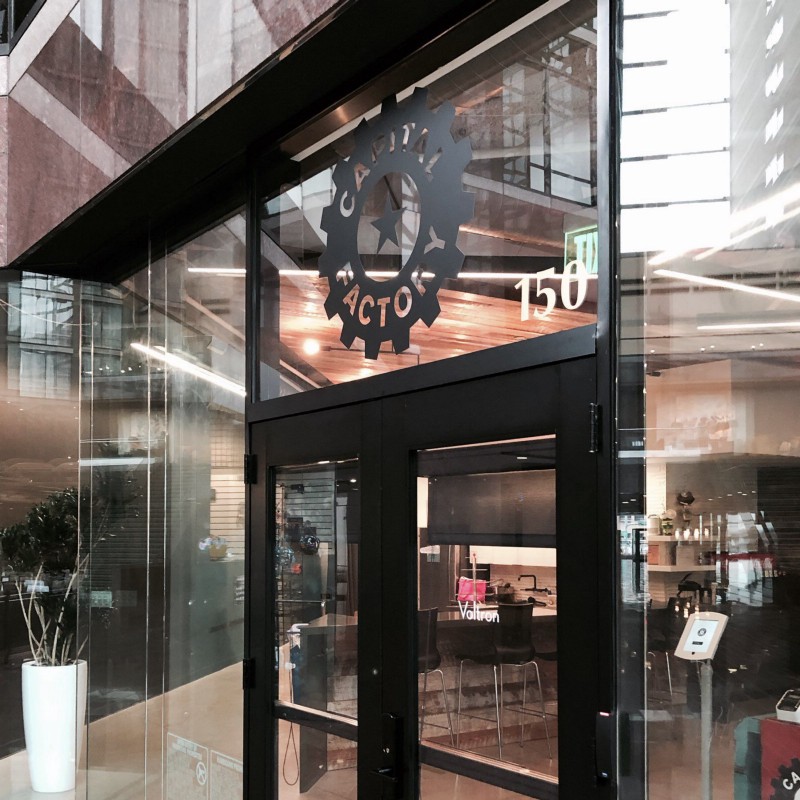
IndieWebCamp starts tomorrow.
IndieWebCamp starts tomorrow. I’m downtown this morning, heading over to Capital Factory to do a walk-through of the venue and make sure we’re all good for the weekend.
Marzipan 2021
On the latest Core Intuition we covered this Bloomberg article from Mark Gurman about Marzipan. Many bloggers have written about it this week, skeptical that Marzipan will ever produce great Mac apps, but maybe we’re not giving enough credit to Apple’s strategy. Let’s start with this part of the article:
By 2021, developers will be able to merge iPhone, iPad, and Mac applications into one app or what is known as a “single binary.” This means developers won’t have to submit their work to different Apple App Stores, allowing iOS apps to be downloaded directly from Mac computers — effectively combining the stores.
Marzipan is a multi-year effort. It exists today mostly as a prototype, not meant for developers, with obvious limitations such as iOS-like controls and sheets poking through in the UI. The next phase will be much more mature. And then by 2021 we’ll have more polish and a consistent App Store submission experience across platforms.
What we can’t predict yet is how users will react to third-party apps. An assumption in the Mac developer community is that native, all-AppKit macOS apps will always be better than iOS apps ported with Marzipan. I believe that too. Apps originally designed for the Mac will have more thought put to the windows, controls, menus — everything that makes an app Mac-like.
But familiarity might be an advantage. What if users end up preferring Marzipan apps simply because they want their apps to work exactly the same across multiple platforms? What if Marzipan is more than “good enough”, but actually exactly what users are looking for, seeing their favorite iOS apps on macOS for the first time? (Again, not the Marzipan of today, which isn’t ready, but the Marzipan of a couple years from now.)
With a unified App Store in 2021, I think it’s likely that Apple will encourage universal apps that have a single price for running across iPhone, iPad, and Mac. While this seems unfair by traditional Mac development standards — when developing for AppKit could be a completely different codebase and depth of features, justifying a separate purchase — for Marzipan it seems reasonable to pay once and get the app everywhere.
Marzipan looks like a very different transition than what we went through with Carbon and Cocoa. As I blogged about in 2003, you could start using Cocoa windows and controls directly in a Carbon app. For Marzipan, it doesn’t appear that you can mix AppKit into a UIKit app. If this holds true, it will split Mac development into 2 paths.
I plan to keep Micro.blog using AppKit, for now. But I wouldn’t bet against Marzipan, and I’ll be looking for what Apple says at WWDC. Not what they say about Marzipan itself, but about AppKit. If the usual “What’s New in Cocoa” session at WWDC is missing or filled with very minor tweaks to AppKit, the writing will be on the wall that UIKit is where we should put all our attention, even on the Mac.
Writing a post today that links back to one of my blog posts from 2003!
Writing a post today that links back to one of my blog posts from 2003! Love it when that happens. You never know what ordinary blog posts today will take on new significance 15+ years from now.
Why attend IndieWebCamp
This weekend is IndieWebCamp Austin, an event for bloggers, web developers, designers, and anyone who wants to create something for their own web site, or to build tools based on IndieWeb standards. You can register here. After my first IndieWebCamp, I wrote:
There’s nothing like meeting in person with other members of the community. I know this from attending Apple developer conferences, but the weekend in Austin only underscored that I should be more active in the larger web community as well.
It’s invaluable to chat with someone in person. This year, we’ll have IndieWeb co-founders Tantek Çelik and Aaron Parecki back in Austin. I’m looking forward to hearing how the IndieWeb has moved forward in the last year.
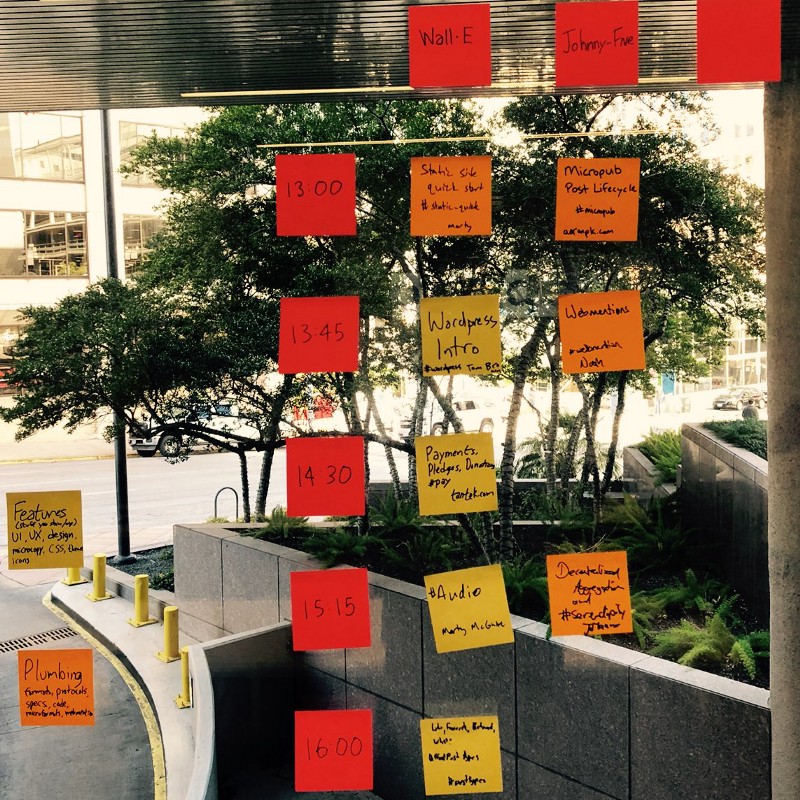
The first day of IndieWebCamp is for introductions and sessions. Topics for sessions are based on what attendees want to hear about, so the planning is done with sticky notes that can be rearranged to find a schedule that works for everyone. This is a photo I took from IndieWebCamp in 2017.
I look at IndieWebCamp as a way to take a break from the day-to-day routine and get inspired again — to improve my own web site or discover a new part of Micro.blog to work on. As I was talking about with Daniel on the latest Core Intuition, because the 2nd day of IndieWebCamp is a hack day, it’s also a great environment to work on something you’ve had trouble finishing… or starting! There are other people around to help answer questions, and a nice block of time to focus on one thing.
If you’re in the Austin area, hope to see you there on Saturday! You can learn more here.
Doors open for IndieWebCamp Austin at 9am on Saturday.
Doors open for IndieWebCamp Austin at 9am on Saturday. We’ll have coffee and breakfast tacos. Full schedule and registration details: 2019.indieweb.org/austin ☕
We just posted Core Intuition 361.
We just posted Core Intuition 361. Looking forward to IndieWebCamp Austin and talking about whether new Marzipan rumors will influence our plans this year.
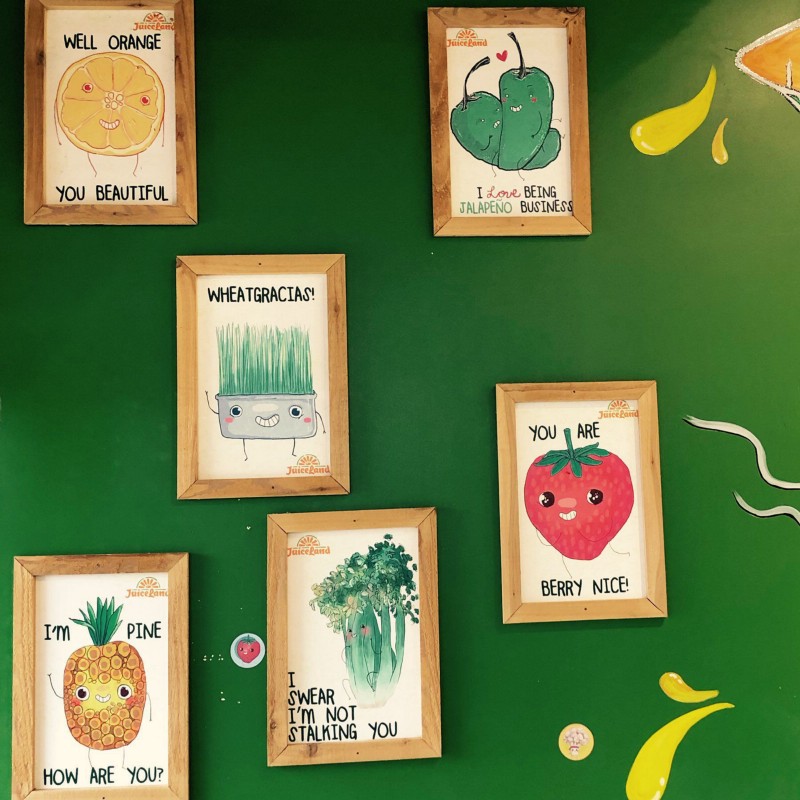
Started the day with JuiceLand. Love these silly prints on the wall.
Started the day with JuiceLand. Love these silly prints on the wall.